orch-hub
A local control plane for AI coding agents — one operator, a portfolio of repos, and year-long projects carried through bounded development sessions.
orch-hub is a control plane I design and build for my own AI-assisted development. It runs resident on my Mac, is operated from a phone over a private network, and coordinates per-repository orchestrator programs that drive autonomous dev/review loops over task files. The source repository remains private, while a public Apple Silicon binary preview now makes the operating experience available without a source checkout.
The protocol those loops actually run is mandrel, which is open source. The division is deliberate: mandrel is what a single repository runs and is useful on its own, with or without a control plane; orch-hub is the layer above it, where a portfolio of repositories becomes one operating surface.
View the binary preview →
Watch the 19-second walkthrough →
View mandrel on GitHub →
The product in use
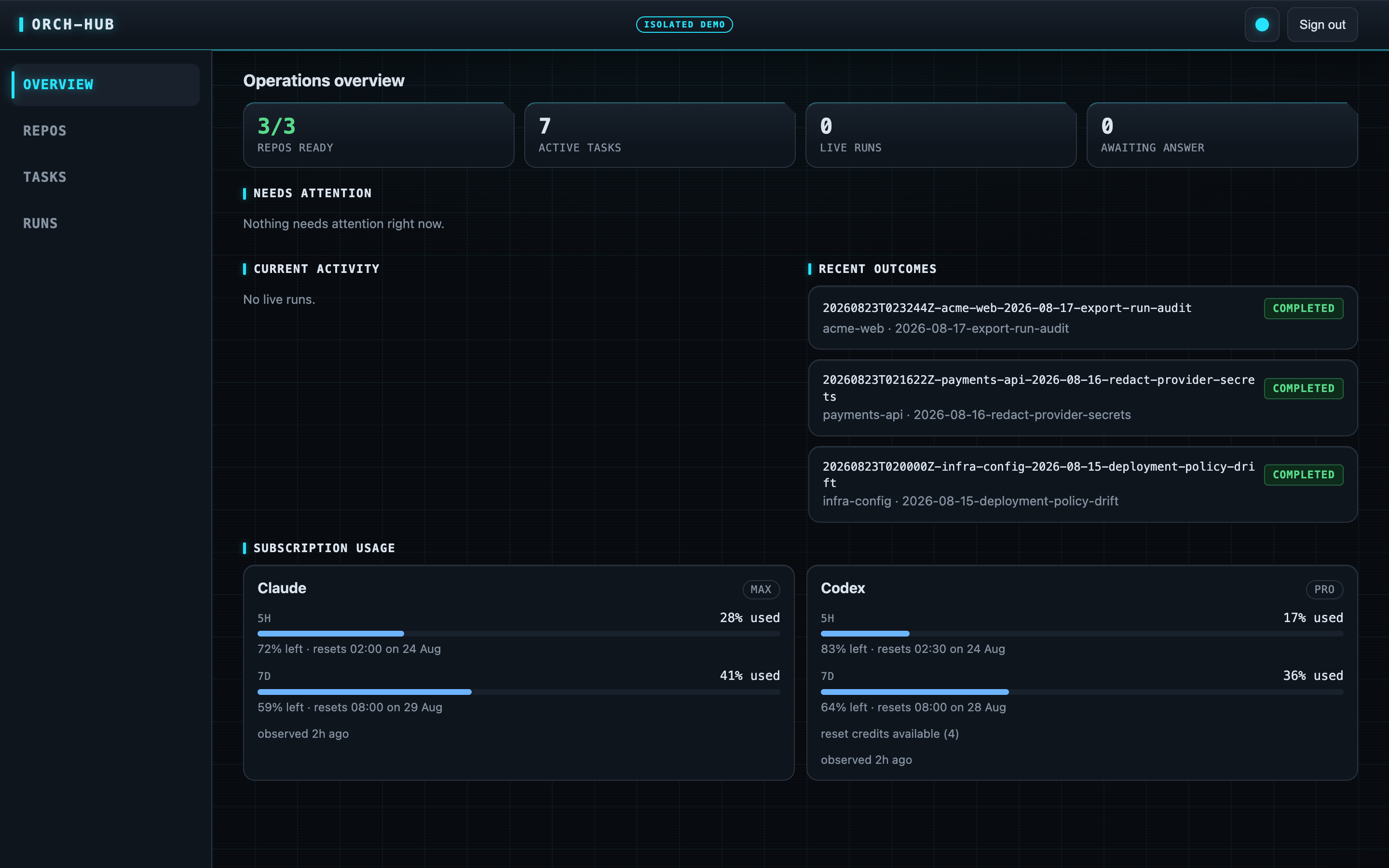
The dashboard keeps the portfolio legible at a glance: repository readiness, active-task counts, recent outcomes, and subscription capacity share one operating surface. The overview makes the state of the whole portfolio visible before the operator drills into any one repository or run.
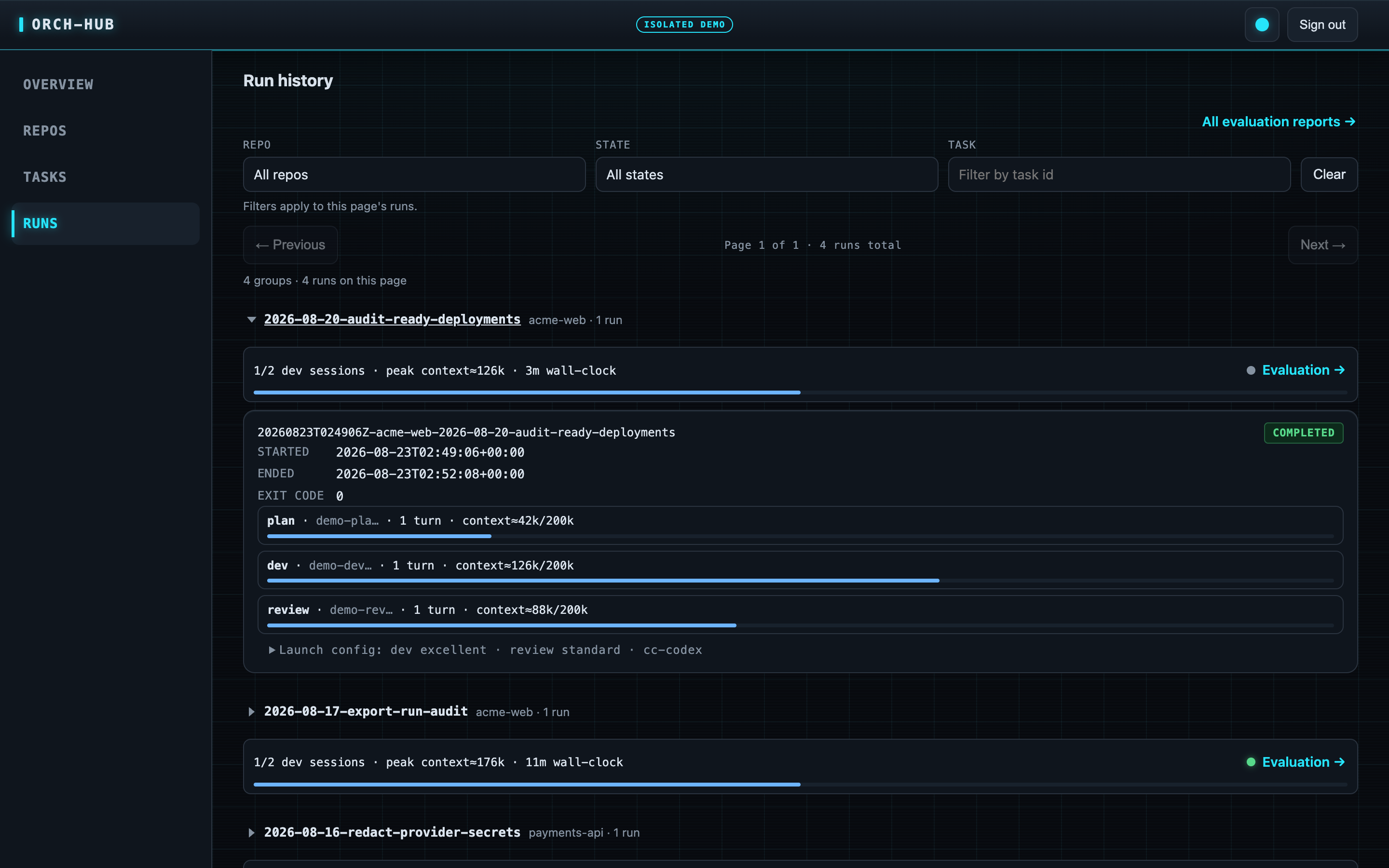
Run history stays organized around durable tasks rather than isolated conversations. Each task groups the development and review sessions that advanced it while retaining wall-clock time, peak context use, launch configuration, and a path to the resulting evaluation.
The public repository distributes preview binaries, installer metadata, screenshots, and the walkthrough under explicit preview terms; it is not a source-code mirror. That boundary lets people evaluate the control-plane experience while the protocol and its documentation remain fully open in mandrel.
The unit is a product lifecycle, not a chat session
A production-grade project is rarely one or two agent sessions — from idea to launch it is months of work across hundreds of sessions. Most AI coding surfaces manage the single session well and leave the time axis to the human. orch-hub manages the layer above: which repos are ready, what each backlog holds, which runs are waiting on a human answer, what happened while you were away — the operating state of a whole portfolio, not a list of conversations.
Bounded working set over unbounded project time
The hub fronts a protocol stack — a task lifecycle plus a curated, machine-parsable project memory — built around one invariant: the working set stays bounded while the project grows without bound. Development sessions are bounded to one effective context window; tasks that need more than one carry an explicit plan and structured handoffs. At completion, admitted durable findings update the timeless snapshot and the complete task record moves to the local archive. The agent in month twelve faces the same bounded shape as the agent on day one — and so does the operator: the interface converges instead of accreting.
Human in the loop, at the right altitude
Agents run autonomously inside a task; human attention is requested at explicit decision boundaries — a question, an optional plan gate, an intake confirmation, or a convergence or dispute escalation. Bark can notify the operator when a run needs input or ends, an intake draft is ready, or a semantic evaluation finishes; answers are given from the phone-first dashboard.
Stack: Python · FastAPI · file-contract IPC with detached orchestrator subprocesses · mobile-first dependency-free SPA · launchd resident service · push notifications · private-network-only, fail-closed bearer auth.