mandrel
An open-source protocol for running AI coding agents on the same codebase for months — bounded working sets over unbounded project time.
mandrel is the protocol underneath the way I do AI-assisted development: task-scoped work, selective project memory, and deterministic control outside the model, deployed into every repository I work in. It is open source under Apache-2.0, and it is the layer orch-hub sits on top of — orch-hub operates a portfolio of repositories, mandrel is what each of those repositories actually runs.
Read the full write-up → · View the repository on GitHub →
The problem is drift, not context length
The failure mode of long-horizon AI-assisted development is not model capability. It is drift: decision history accumulating without curation until neither the human nor the agent can face it. Note the axis — drift is a function of project time, not project size. A hundred thousand lines generated in a week has almost none; twenty thousand lines iterated over two years is where it becomes lethal. What accumulates is not code, it is the sediment of choices made and reversed.
Longer context windows do not fix this. The window fills with the transcript of how you got somewhere rather than the conclusions, and capacity was never the binding constraint — precision is.
One invariant
The working set stays bounded over unbounded project time.
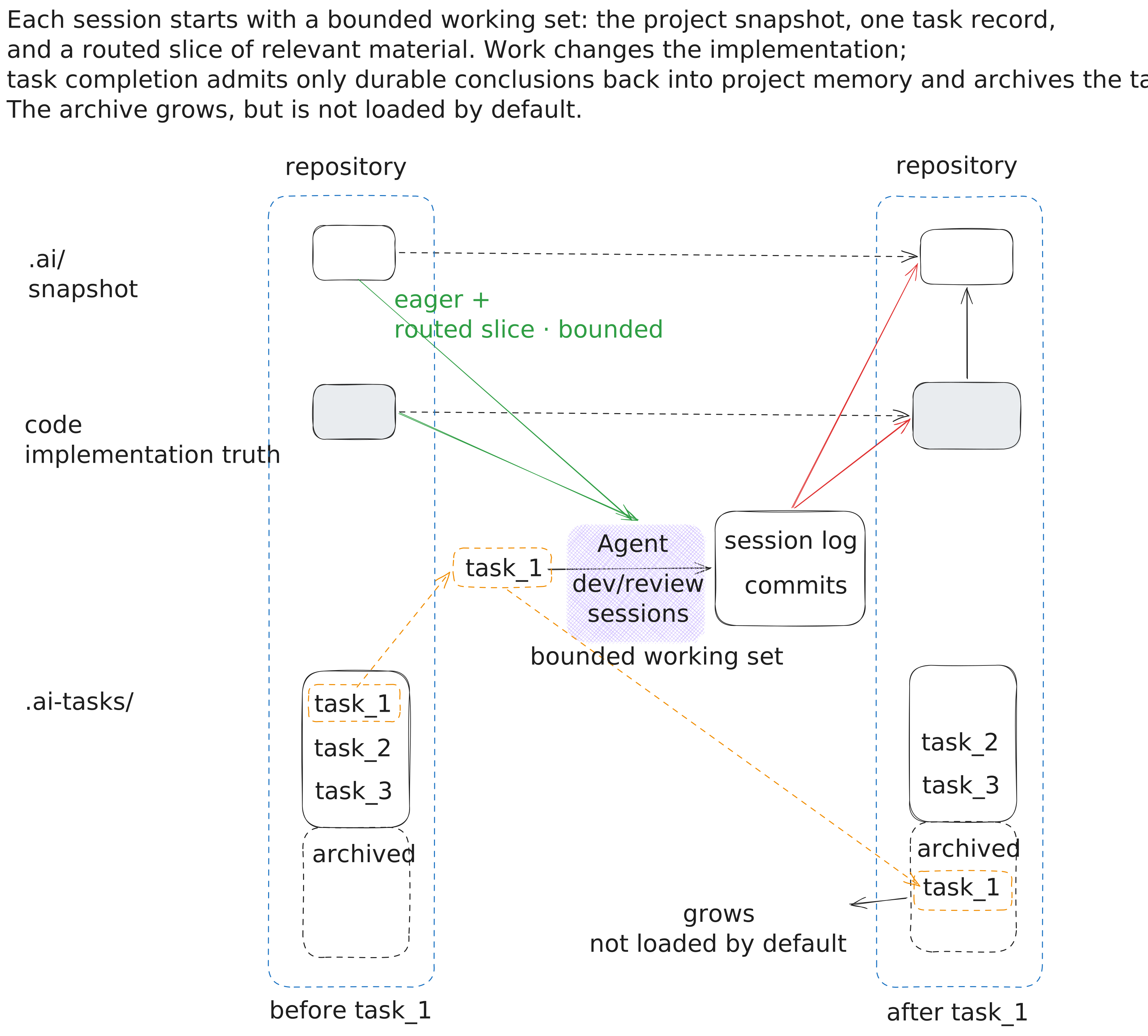
Day 1 and day 300, a fresh session faces the same shape of context: a small constant set of project invariants, one task, and a routed handful of relevant documents. The corpus behind it grows. The slice is bounded by the task rather than being allowed to grow merely because the project is older.
Three mechanisms
Development work is estimated in context-window units. When it needs another development session, the task file carries a structured handoff, and every handoff loses information. The protocol’s job is not to make handoffs lossless — that is unachievable — but to make them rare and structured. The task file carries the full lifecycle: development, fresh-context review, remediation, handoff, and completion. Review converges through frozen finding groups, delta-only re-review, and one-shot human escalation.
Memory admits rather than accumulates. Initialization creates the project snapshot. Ordinary work sessions never write it; durable task findings enter at completion closeout, while explicit housekeeping is the separate maintenance path. A fact must pass three tests to enter: is it expensive to re-derive, does it stay true, and does knowing it change what the agent does next. What passes are invariants, non-obvious couplings, anti-patterns, and intentional omissions — the category no amount of reading recovers, because absence leaves no trace in the code.
Deterministic control lives outside the model. A caller re-parses the task file, selects the next legal role, builds the role prompt with its contract and entry checklist, verifies declared outputs, counts convergence budgets, and escalates decisions it may not make. Backend hooks or imports provide eager context; task frontmatter tells the session which additional documents to preload.
What the protocol does not trust
The suite is layered by a single question: can a model decline to comply? Contracts, role specifications, and skills are semantic — they work by being read and understood, which means they work most of the time. Session hooks and the scheduler’s output verification are mechanical: they run outside the model’s judgment and cannot be reasoned with.
That split is the design. The semantic layers carry everything requiring judgment, because only a model can supply it. The mechanical layers carry the few properties that must hold regardless — the tree is clean, the handoff exists, the declared output is really there — and they are deliberately few, because every mechanical check is a rule you can no longer change by argument.
Two interchangeable executors
Role contracts are anonymous and self-contained: a session never learns that other kinds of session exist, and the caller owns all sequencing. That is what lets a human run the loop by hand and a headless scheduler run it unattended, from the same runbook, with byte-equivalent delivery — you can take the wheel at any session boundary and the scheduler picks up where you left off. Automation you cannot step into is automation you must trust completely or abandon completely.
In use
Five months across four repositories, 286 completed tasks, the largest a ~122k-line Go service whose curated snapshot sits at ~34k words. The protocol was introduced to that codebase ten months after its first commit — a brownfield adoption, which is the situation most readers are actually in.
Stack: Markdown contracts · Python deployment and drift-detection CLI · Bash session hooks for three agent surfaces · a headless dev/review scheduler · a deterministic verification gate.